


I’m in a client meeting. We’re reviewing Analytics. They notice a lot of “Direct traffic” and they ask me what it includes. I start explaining …and they are surprised by the answers.
This isn’t unusual. I’ve found that a lot of marketers don’t fully understand what it includes or appreciate its value. Yet a huge amount of traffic in GA4 is “Direct.”
It’s probably at or near the top of your own Traffic acquisition report. It almost always is.
Direct traffic is the largest of all traffic channels. We looked at 145 Google Analytics accounts and “Direct” was the number one or number two channel for 92% of them. Across the 56 million sessions recorded, 36% of traffic is categorized as direct. That’s a lot.
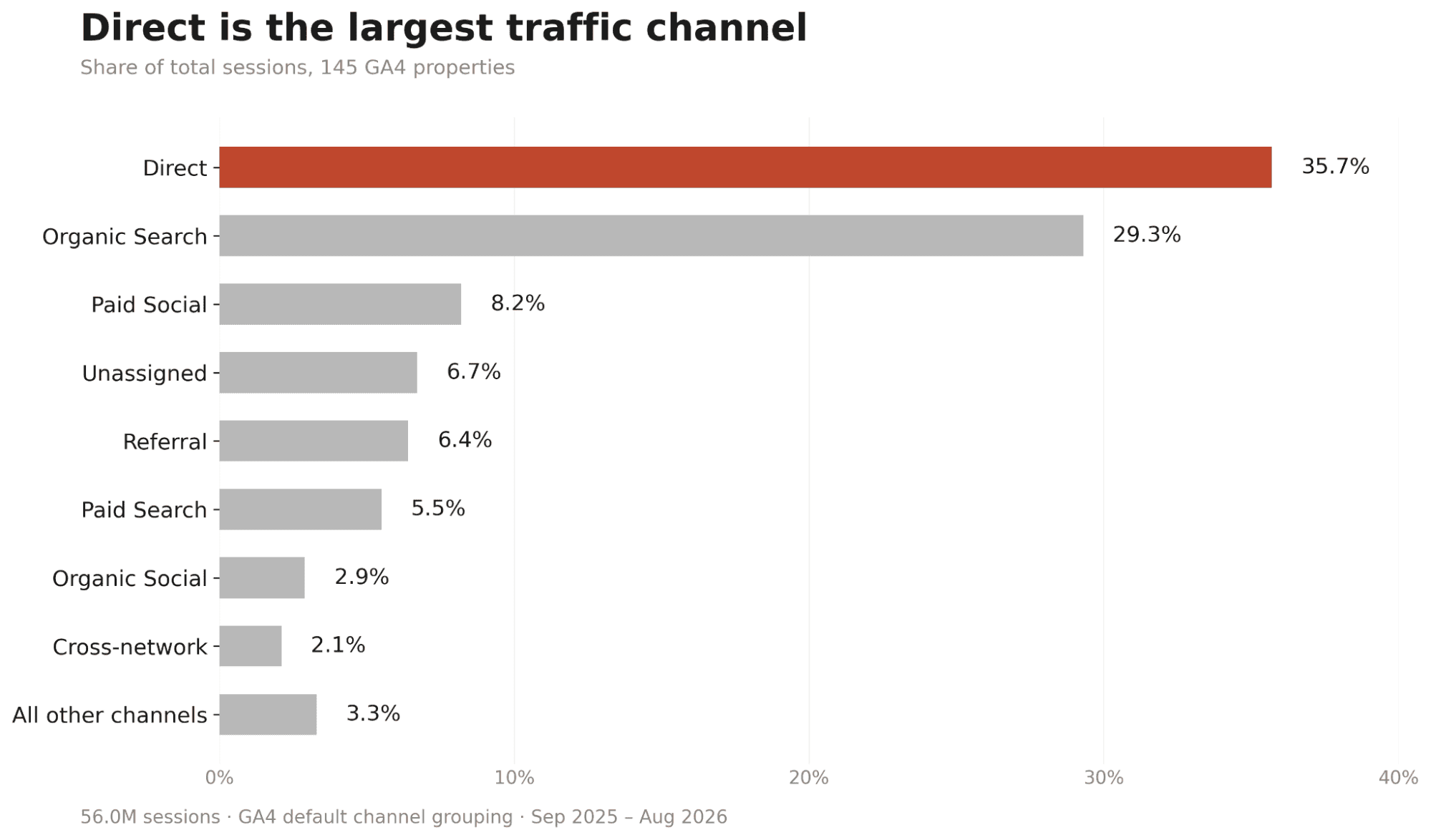 For the biggest and best-known brands, Direct is by far the largest source of traffic. According to Similarweb’s benchmark report, for the highest-traffic sites, 65% of their traffic is Direct. The stronger your brand, the more direct traffic you have.
“Direct” is probably the least understood and most important traffic channel.
Most marketers treat direct traffic like an Analytics problem. But it’s actually the best brand metric in your analytics. And it’s also the only channel big tech can’t take away from you.
Today let’s take a few minutes to refresh ourselves on this underrated metric. This little guide will answer three questions:
- What traffic gets categorized as “Direct?”
- What does this metric really measure and why does it matter?
- How can marketers increase direct traffic? ← I’ve been in a million meetings, but I’ve never once heard this question.
Scan through and see if the answers surprise you.
What traffic gets categorized as “Direct?”
All kinds of traffic, really. Here’s a quick list showing what they did, then what it means.
- Visitor typed in your URL (brand awareness or offline exposure)
- Visitor clicked a bookmark or selected your URL from browser history (prior brand experience)
- Visitor clicked a link in a file: PDF, PPT, DOCX, etc. (engaged with content beyond the website)
- Visitor clicked a link in an app: email, Slack, SMS, AI, etc. (recommendation or word of mouth)
- Visitor arrived through any link where attribution was lost (tracking issue)
Yes, it could be that your URL was typed into an address bar (we all knew that). But it could also be any untagged link clicked in anything that wasn’t a browser (like a QR code). Or it could be just a tracking issue (a bad UTM parameter or a redirect).
In the addendum at the end of this guide, we’ve added a flowchart that shows exactly how GA4 decides how to categorize traffic.
What does direct traffic really indicate?
Look back at the list. Here it is again but with each item flipped:
- Brand awareness or offline exposure (Visitor typed in your URL)
- Prior brand experience (Visitor clicked a bookmark or selected your URL from browser history)
- Engaged with content beyond the website (Visitor clicked a link in a file: PDF, PPT, DOCX, etc.)
- Recommendation or word of mouth (Visitor clicked a link in an app: email, Slack, Teams, SMS, AI, etc.)
Looks different, doesn’t it? Suddenly, “Direct” looks like an excellent indicator of awareness and reputation. Rather than an attribution problem, it’s a brand measurement metric.
Direct traffic is a “Brand Strength Indicator.”
This is a strange idea for performance marketers, but perfectly natural for brand marketers. (Yes, these are the two kinds of marketers). And because most GA4 users are performance marketers seeking accurate attribution, direct traffic is highly underrated. Here’s a lighthearted take on the differences in perspective…
Two marketers walk into a bar. Each orders a Direct Traffic Special.
The bartender says, “Here you go. It’s a mix of everything I couldn’t identify.”
The performance marketer asks, “Where’d this come from? I have no idea what’s in this.”
The brand marketer says, “Who cares? Everybody here knows its name. We need another round!”
If the goal of marketing is to grow a brand, then direct traffic is your best indicator of success.
Once you have an established brand, you have short-circuited all of the digital marketing channels. You are no longer beholden to big tech to send traffic. You are less reliant on advertising. The visitor doesn’t search or ask AI. They come straight to you. They visit directly.
 | Wil Reynolds, Seer Interactive“People are sharing links with other people. I can’t track their referring source, so that’s direct traffic growing. These trust channels are so much more efficient. The problem is, they’re really hard to track. We like the easy to track shit.” |
The power of branding is right there in your GA4 data. You can see it in two ways: changes in direct traffic (Traffic acquisition with a YoY comparison) and the conversion rate from Direct (session key event rate for a high-intent action such as lead generation).
When we look at those across a large number of GA4 accounts, two things become obvious: consistency and quality. Let’s look at each.
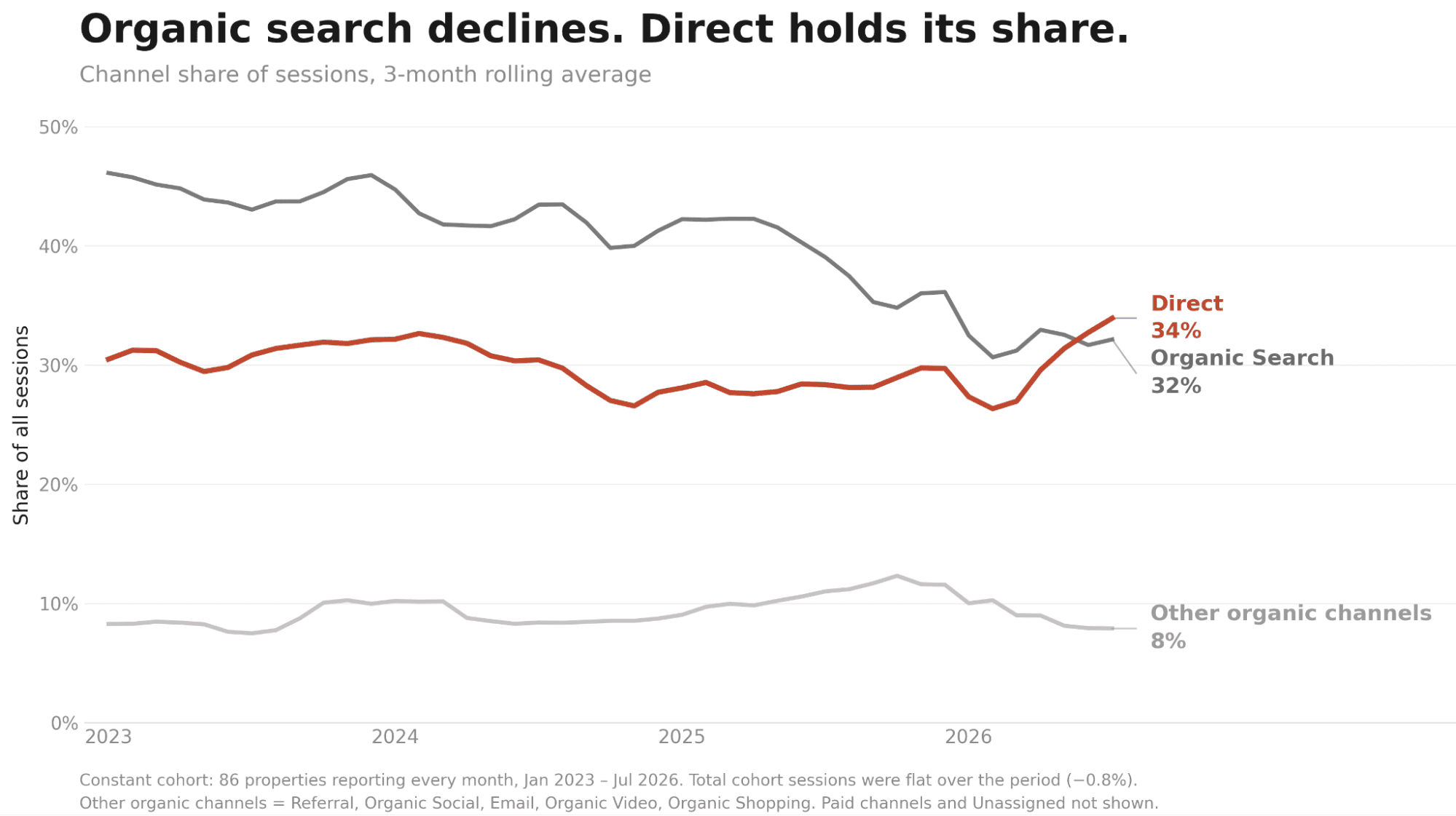
Direct traffic is undisrupted
It’s a steady source of traffic over time, undisrupted by changes to search. In fact, as a share of all traffic, it’s on the rise. Here we see the percentage of traffic that is categorized as direct across 86 accounts with 140M visits over 3.5 years.
Direct traffic visitors drive demand
It’s a consistent source of form fills. Organic search and referral traffic convert at higher rates, but Direct is a huge contributor to total demand generated.
We looked across 143 properties and found Direct was the second-largest source of leads, producing 27% of all demand.
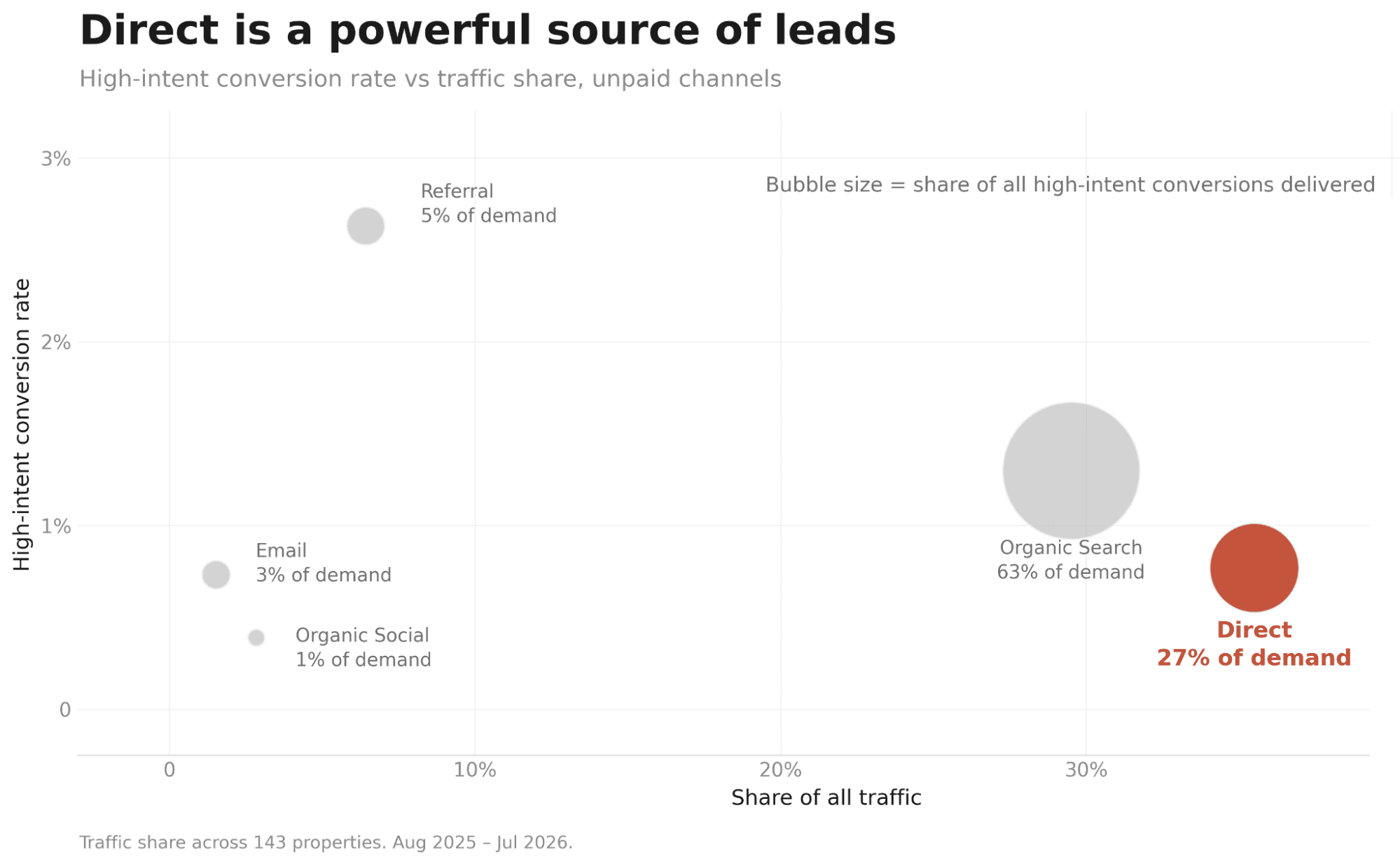
Note: Some “organic search” traffic is really people searching for the brand (navigational queries) which are really the same as direct traffic. So the actual power of the brands is stronger than any direct traffic analysis shows.
 | Goldie Chan, Founder at Warm Robots & Author of Personal Branding for Introverts |
The quality of this traffic is excellent. The conversion data shows two things about direct traffic.
- Direct has high conversion rates for high-intent actions (contact us, request a demo, get started, etc.)
- Direct has low conversion rates for low-intent actions (subscribe, download resources, etc.)
As a brand becomes better known, it becomes less dependent on organic and paid channels for discovery and demand. Prospects stop looking for it and start going to it directly to get help. Awareness and trust are in place.
Traffic consistency and quality. Two things every marketer should love. Which brings us to our final question…
How can I increase direct traffic?
It’s a question no one is asking. But we’ll answer it anyway. Here are 10 ways to increase direct traffic. It’s basically a list of actions that build brands but drive unattributable traffic. We’ve ranked them by likelihood of business impact for B2B brands.
- Referrals and word of mouth
In project close meetings, at quarterly check-ins, ask if they know anyone else you can help. Build reciprocal relationships with partners. A genuine recommendation converts better than anything else …and shows up as direct. - Publish original research on an annual cycle
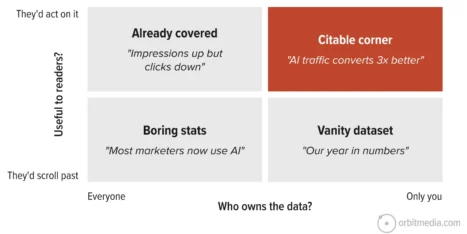
Recurring studies (“State of X 2026”) are the compounding assets. They create a reason to return on a schedule, year after year. Because they get bookmarked, cited and revisited …they show up as direct. - Run an email newsletter with real subscriber loyalty
Consistent email programs drive genuine brand awareness and repeat visits. And if the links are untagged or their email program strips the referrer …they show up as direct. - Speak at events
Give a presentation to a room of people in your target audience. If it’s practical, relevant and memorable, the attendee then types in your URL (or scans an untagged QR code in a slide) …they show up as direct. - Be a guest on (or sponsor) podcasts
Listeners can’t click. This is why podcast performance attribution is a nightmare. But if the listener was impressed or the host-read sponsorship was relevant, they type your brand …they show up as direct. - Build a free tool
Tools get revisited in ways articles don’t. For example, if someone bookmarks our AI Bot Access Checker and uses it every month …they show up as direct. - Get active in online communities
Your future buyer may be active in private professional groups. If someone recommends you in Slack or WhatsApp …they show up as direct. - Sponsor something: industry and community
Industry association sponsorships (events, emails, logo placement) grow visibility with the same qualified audience repeatedly. Community sponsorships (sports, schools, nonprofits, fundraising events) do the same locally, and support causes you care about. When these people eventually visit …they show up as direct. - Local broadcast: TV and radio
Broadcast has been written off by most B2B marketers, which is why it’s uncontested. The geographic and demographic targeting may be excellent, but because they don’t give listeners or viewers anything to click …they show up as direct. - Invest in offline marketing: print, swag, signage and direct mail
Yes, it may be the lowest measurable ROI with the longest lag. Like broadcast, it’s a category that performance marketers have abandoned. When offline impressions drive visitors …they show up as direct.
None of these produce clicks you can accurately trace, which is why they’ve been defunded by the performance marketers and optimizers. But the audience they attract converts on high-intent actions at roughly the rate a search visitor does.
One more channel belongs on that list…
What about AI mentions?
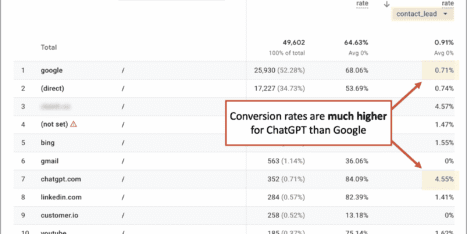
AI search optimization is similar to word-of-mouth marketing. It’s just the words of an artificial mouth. And like WOM, traffic is low but conversions are high. AI traffic is both part of a complex buyer journey and difficult for Google Analytics to track.
- Someone reads an AI answer, leaves the conversation, and types your URL later. That’s genuine brand awareness …and they show up as direct.
- Someone clicks a link in an AI answer and GA4 fails to classify the referral. That’s a measurement problem …and it inflates direct traffic numbers.
Both of these do the same thing: direct gets bigger. And yes, GA4 now has an AI Assistant channel, but it catches only some of this traffic. Yet again, the rest land in direct.
Direct traffic is evidence your marketing is working
Direct isn’t just an Analytics problem. And it really isn’t a channel you can optimize. It’s more important than that. It’s about delivering massive, consistent volume from people who already care about your brand.
It’s the outcome of building a brand.
Because of its value and challenges, I have two predictions in the years to come…
- I predict an increase in direct traffic, especially as a share of all website traffic. After all, it’s one of the few metrics that isn’t subject to changes in big tech.
- I predict an increase in the importance of this metric, especially as attribution gets harder because AI becomes a bigger part of the buyer journey.
Addendum: How traffic is categorized by GA4
Marketers work hard to fix tracking issues and tag links for more accurate tracking. That’s good. But in the end, “Direct” is still the “Google doesn’t know” bucket. It’s last in the decision flow that GA4 uses to categorize traffic.
Ever seen this? This is the flowchart that shows how mediums, sources and channels work in Google Analytics:
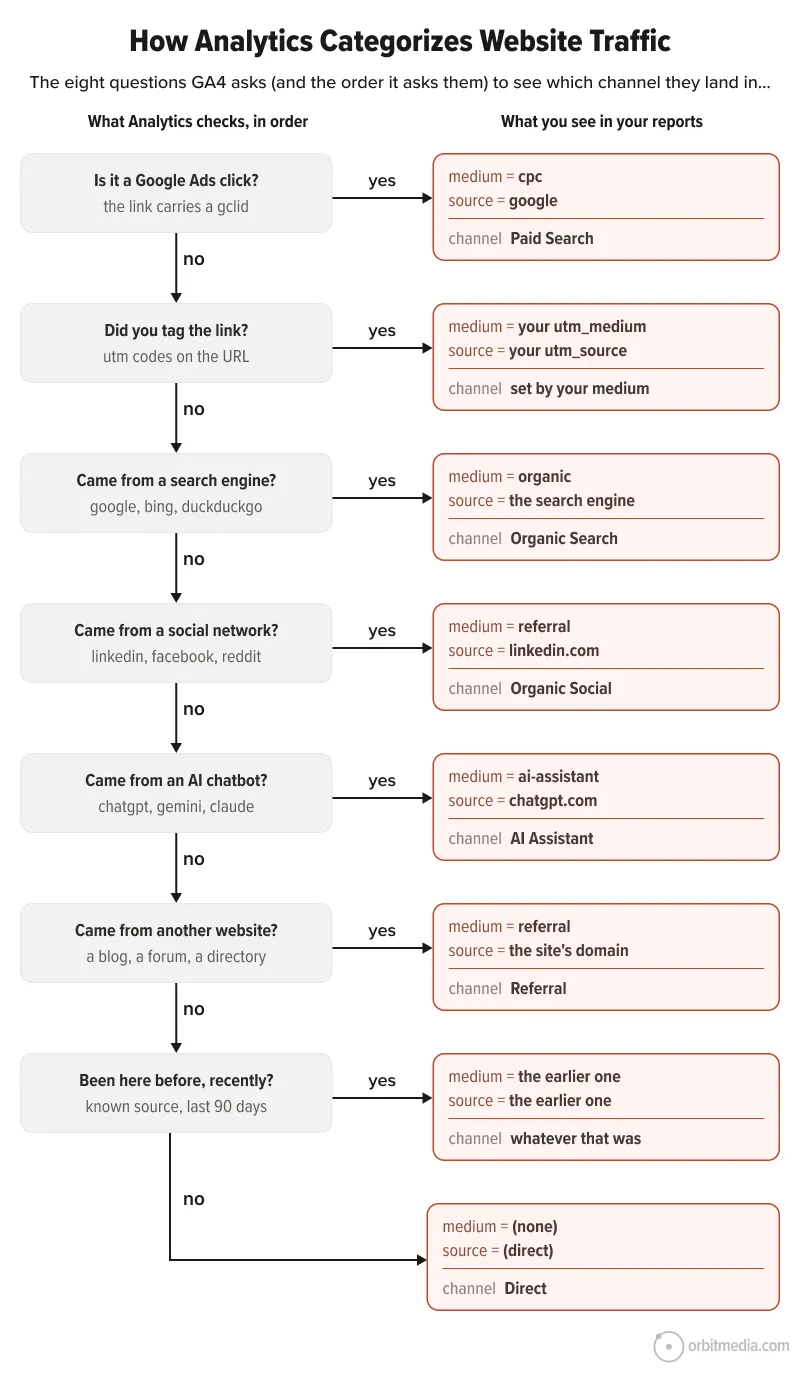
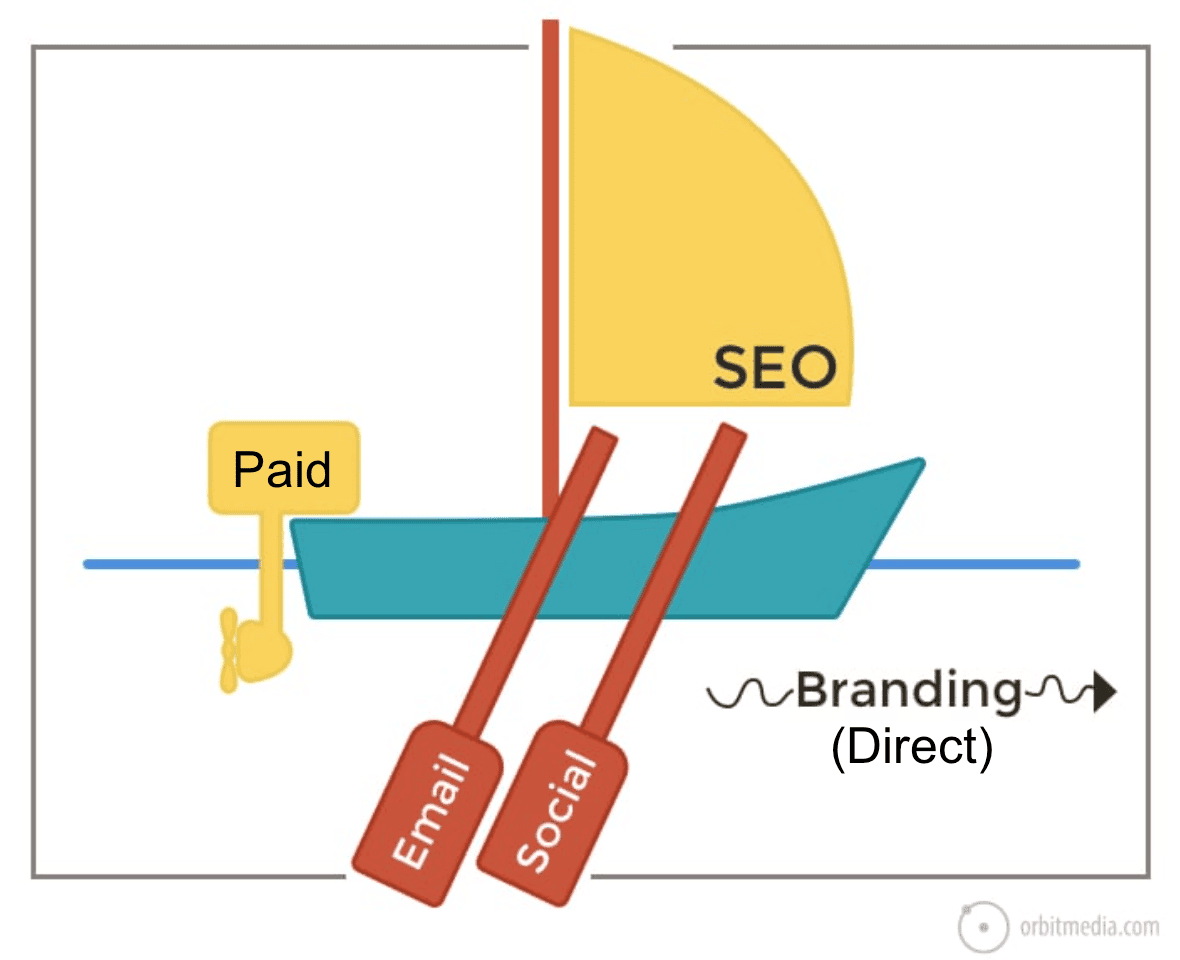
The technical definition of all 18 traffic sources is in our complete guide on traffic sources. That’s the one with the boat metaphor some people like. Direct traffic (and branding) is the current under the boat.

There is more where this came from…
The best content from this blog are available all in one place – our book. Now on its 7th edition.
Content Chemistry, The Illustrated Handbook for Content Marketing, is packed with practical tips, real-world examples, and expert insights. A must-read for anyone looking to build a content strategy that drives real business impact. Check out the reviews on Amazon.
The post Direct Traffic in GA4: What It Really Measures (and 10 Ways to Increase It) appeared first on Orbit Media Studios.